 Apparel & Accessories
  Vehicles & Parts
  Toys & Games
  Sporting Goods
  Office Supplies
  Luggage & Bags
  Home & Garden
  Hardware
  Furniture
  Copied
Go to and paste the code at the checkout to enjoy
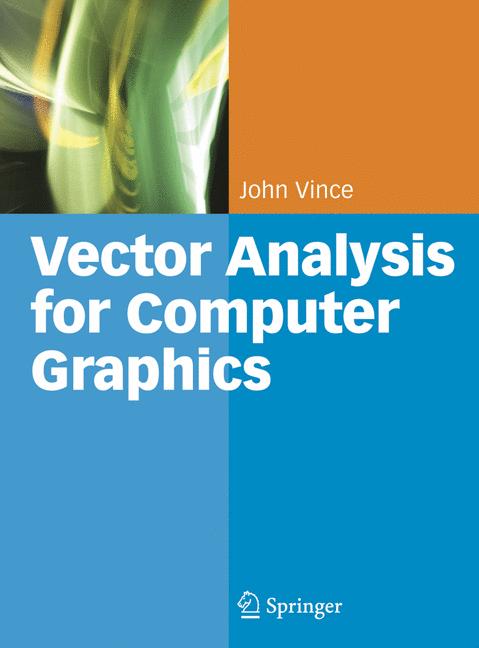
Vector Analysis for Computer Graphics
Best Price:
Buy Vector Analysis for Computer Graphics for $39.99 at @ Link.springer.com
No coupon is required — this is the standard retail price.
Set a price drop alert to never miss an offer.
Price Comparison
| Seller | Contact Seller | List Price | On Sale | Shipping | Best Promo | Final Price | Volume Discount | Financing | Availability | Seller's Page |
|---|---|---|---|---|---|---|---|---|---|---|
|
BEST PRICE 1 Product Purchase
|
|
$39.99 | $39.99 |
|
$39.99 | See Site | In stock | Visit Store |
Product Details
In my last book, Geometry for Computer Graphics, I employed a mixture of algebra and vector analysis to prove many of the equations used in computer graphics. At the time, I did not make any distinction between the two methodologies, but slowly it dawned upon me that I had had to discover, for the first time, how to use vector analysis and associated strategies for solving geometric problems. I suppose that mathematicians are taught this as part of their formal mathematical training, but then, I am not a mathematician! After some deliberation, I decided to write a book that would introduce the beginner to the world of vectors and their application to the geometric problems encountered in computer graphics. I accepted the fact that there would be some duplication of formulas between this and my last book; however, this time I would concentrate on explaining how problems are solved. The book contains eleven chapters: The first chapter distinguishes between scalar and vector quantities, which is reasonably straightforward. The second chapter introduces vector repres- tation, starting with Cartesian coordinates and concluding with the role of direction cosines in changes in axial systems. The third chapter explores how the line equation has a natural vector interpretation and how vector analysis is used to resolve a variety of line-related, geometric problems. Chapter 4 repeats Chapter 3 in the context of the plane.
Reviews
Questions & Answers

Affective Computing for Social Good
$219.99
Low Dimensional Structures Prepared by Epitaxial Growth or Regrowth on Patterned Substrates
$169.00
Sicherungsmanahmen gegen Bergschden und Erdbeben sowie ihre Auswirkungen auf neuere konstruktive E
$69.99
Legitimitt des Chinesischen Ansatzes zur Terrorismusbekmpfung
$74.99
Educational Governance als Forschungsperspektive
$54.99
Sustainable Advanced Technologies for Industrial Pollution Control
$219.99
A Whole New World
$44.99
Whiteness, Class and the Legacies of Empire
$54.99
Economic Theory and International Trade in Natural Exhaustible Resources
$54.99
Handbuch Unternehmenssicherheit
$109.00
Der vlkerrechtliche Status des Westjordanlandes und des Gaza-Streifens nach den Osloer Vertrgen
$119.00
The Selection of Doses in Chronic Toxicity/Carcinogenicity Studies
$54.99
Praktische Funktionenlehre
$49.99
Neuronal Morphogenesis
$159.99
Drug Use in Pregnancy: Mother and Child
$39.99
Elektrotechnik fr Fachschulen
$54.99
Progress in theoretical vegetation science
$219.99
Algebraic Topology and Related Topics
$139.00
Critical Information Infrastructures Security
$44.99
Urban Air Quality: Monitoring and Modelling
$84.99
The West African Slave Plantation
$54.99
Reviews of Environmental Contamination and Toxicology Volume 218
$109.99
Tuberkulose-Jahrbuch 1950/51
$59.99
Choreographic Practice in Online Pedagogy
$149.99
Mapping the Diversity of Nature
$109.99
Privacy and Identity Management for the Future Internet in the Age of Globalisation
$39.99
Performance Evaluation Software
$54.99
Lunar Gravimetry
$39.99
Environmental Clashes on Native American Land
$54.99
Audio- and Video-based Biometric Person Authentication
$39.99
Agenda 2030 Armut
$17.99
High-Performance Computing and Networking
$84.99
Betriebliche Mitarbeiterbildung
$59.99
Scalar Boson Decays to Tau Leptons
$109.99
Momordica genus in Asia - An Overview
$109.99
Motor Control
$39.99
Die Maske der Scham
$64.99
Computer Safety, Reliability, and Security. SAFECOMP 2023 Workshops
$79.99
Walt Whitman
$6.71
Towards Cleaner Entrepreneurship
$129.00

